
When most people hear the words “power surge,” they immediately picture a dark, stormy night in Little Rock, a jagged bolt of lightning striking a transformer, and a sudden pop as the lights go out. While lightning strikes are certainly the most dramatic cause of electrical surges, they are actually the rarest. In fact, if you are waiting for a thunderstorm to think about protecting your electronics, you’ve already missed hundreds of smaller surges that have likely occurred in your home this week alone.
A power surge (or more accurately, a transient voltage spike) is a sudden increase in voltage that significantly exceeds the standard flow of electricity (typically 120 volts in a standard U.S. outlet). These spikes aren’t just one-time catastrophes; they happen daily within your own home. They move silently through your wiring, often without causing a flicker in your lights, but they are far from harmless. Without the right defenses in place, these constant micro-surges act as a hidden tax on your technology, silently degrading your expensive electronics and appliances over time.
The Origin Story: Internal vs. External Causes
To protect your home, you first have to understand where the “enemy” is coming from. Surges are generally categorized into two groups: external and internal.
External Surges
These are the heavy hitters. Beyond the famous lightning strike, external surges are often caused by switching in the utility grid. When the power company reroutes electricity to balance the grid or repairs a nearby downed line, the sudden “push” of restored energy can create a massive voltage surge that rushes into every home on the block. Animal interference (the classic squirrel on a transformer) or a car accident hitting a utility pole can also trigger these high-energy events.
Internal Surges
Surprisingly, roughly 60% to 80% of all power surges originate inside your own home. Think about your air conditioner, your refrigerator, or your washing machine. These appliances use motors that require a massive “gulp” of electricity to start up. When the motor kicks in, it momentarily draws a high current, and when it shuts off, the energy flowing to the motor has to go somewhere. It bounces back into your home’s electrical system, creating a small but significant voltage spike. Because these appliances cycle on and off all day, your sensitive electronics, like your smart TV, laptop, and microwave, are being hit by these mini-surges dozens of times every 24 hours.
The Path of Least Resistance
Electricity is often compared to water, and for good reason. Just as water in a pipe seeks the easiest path to the ground, high-voltage surges look for the path of least resistance through your home’s wiring. When excess voltage enters your system, it doesn’t just sit in the wires; it surges, looking for a way out.
In a perfectly protected home, that surge would be safely diverted to the grounding wire and sent into the earth. However, if your home’s grounding system is outdated or if you lack specialized protection, the surge will find its own path. Often, that path is through the delicate internal circuitry of the devices you have plugged in. The surge moves through the copper wiring in your walls, hits the outlet, and travels up the power cord into your device. Because modern electronics are packed with micro-components that operate on very low, precise voltages, even a small “wave” of extra energy can be overwhelming.
The “Electronic Rust” Effect
When a massive surge hits, like from a lightning strike, it usually results in immediate, catastrophic failure. You might see smoke, smell ozone, or find that the device simply won’t turn on. But the real danger for most homeowners is the cumulative effect of those smaller, daily internal surges.
In the electrical industry, we call this “electronic rust.” Just as a bridge doesn’t collapse from a single drop of rain, but rather from years of slow oxidation and rust, your electronics don’t usually die from one internal surge. Instead, each small spike creates a tiny amount of heat that microscopically damages the semiconductor chips and circuitry. Over months and years, these “micro-burns” weaken the components.
Have you ever had a computer or a television that was only three years old and suddenly “died for no reason”? More often than not, it wasn’t a manufacturer’s defect but the cumulative toll of thousands of mini-surges that finally eroded the hardware until it could no longer function.
Power Strips vs. Whole-Home Surge Protection
When homeowners realize they need protection, they often head to the store and buy a dozen plastic power strips. While some of these are better than nothing, it’s important to understand the difference between a simple “power strip” and professional surge protection.
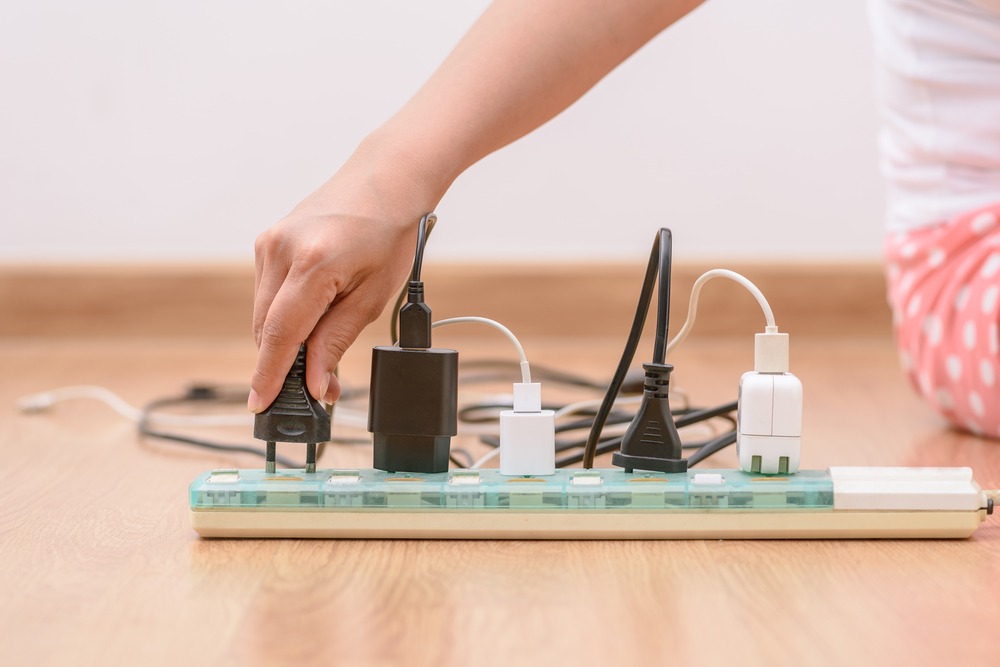
Most cheap power strips are just “multi-tap” extensions that provide more outlets but offer little to no surge protection. Even those labeled as “Surge Protectors” have a limited capacity (measured in Joules). Once they’ve absorbed enough small surges, their protective components wear out, often leaving your devices powered but totally unprotected without you even knowing it. Additionally, a power strip can only protect what is plugged into it; it offers no protection for hardwired appliances, such as your oven, HVAC system, or smart lighting.
Whole-Home Surge Protection is a different beast entirely. These devices are installed directly into your main electrical panel by a professional. When an external surge from the utility company or a lightning strike hits, the whole-home protector senses the excess voltage and “shunts” it safely to the ground before it ever enters the branch circuits of your home. It acts as a primary shield for the entire house, protecting everything from your $2,000 refrigerator to the delicate sensors in your air conditioner.
The Staley Electric Commitment
At Staley Electric, we have spent years building a reputation as the most reliable and efficient electrical solution provider in Little Rock and the surrounding areas. We understand that your home is your biggest investment, and the technology inside it, from your home office to your kitchen, is essential to your daily life.
We don’t believe in “one-size-fits-all” hardware. Our commitment to excellence means we use only top-tier, professional-grade surge protection products that offer significantly higher Joule ratings and faster response times than anything you can find on a retail shelf. Our technicians are experts at assessing your home’s grounding system to ensure that, when a surge occurs, it has a safe path to ground. We take pride in our unblemished reputation for service, ensuring that every installation is neat, code-compliant, and built to last.
Don’t wait for the next Arkansas thunderstorm to find out if your electronics are vulnerable. If you live in Little Rock or Central Arkansas, call Staley Electric today. Our professionals are ready to install a whole-home surge protection system that gives you true peace of mind.